This question keeps coming back every year, usually around sale season, or when someone’s phone slows down just enough to become irritating but not broken enough to force an upgrade.
I’ve answered it differently at different points in my life. That alone should tell you something.
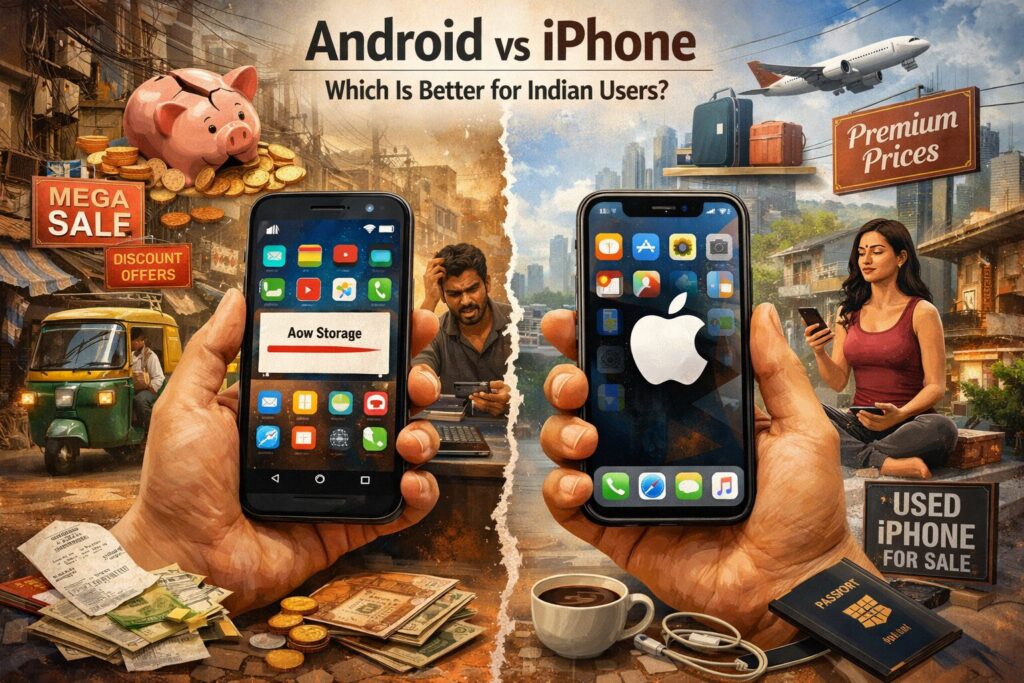
When people ask Android vs iPhone, they often think they’re asking about cameras, performance, or “which is more powerful.” In India, that’s almost never the real conflict. The actual tension is quieter and more personal. It’s about whether the phone will still feel like it belongs to you after six months. Whether it fits your money habits. Whether it quietly makes life easier or keeps nudging you into compromises you didn’t expect.
Most comparison pieces don’t start there. They start with specs. I won’t.
This is written from living with both ecosystems in India — paying for them, fixing them, reselling them, cursing them, occasionally admiring them. No brand relationships. No ideal user profile. Just how these phones behave when they’re not being reviewed anymore.
Table of Contents
Who is actually searching for this — and why now
Usually, it’s one of three people.
The first is an Android user who has never owned an iPhone but feels the pull. Maybe colleagues use iPhones. Maybe photos on WhatsApp look better when sent from one. Maybe they’re tired of software clutter and want “peace.”
The second is the iPhone user who feels boxed in. Storage anxiety. Repair costs. That moment when you realise a basic cable costs more than a decent pair of wired earphones.
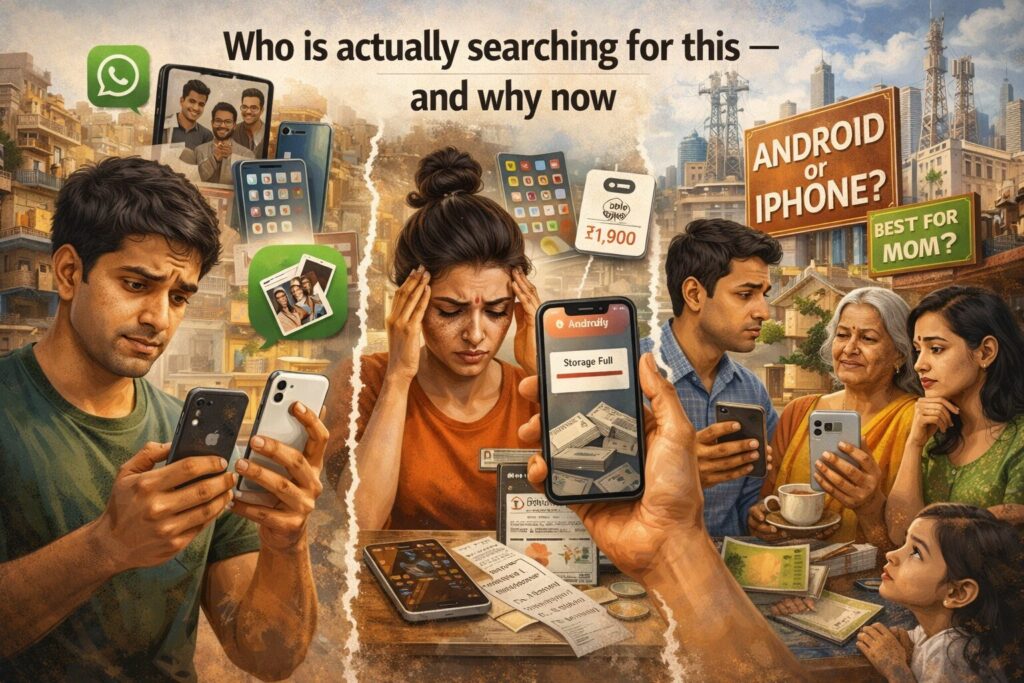
The third group is buying for someone else — a parent, a spouse, a child — and suddenly the decision feels heavier. You’re not buying a gadget. You’re buying future inconvenience or relief.
India adds its own layer of confusion. Prices don’t map cleanly to global reviews. Service quality varies city to city. Network reliability behaves differently depending on where you live, not just which SIM you use. And resale value, strangely, matters almost as much as purchase price.
The money part (because pretending it doesn’t matter is dishonest)
Let’s talk rupees before philosophy.
Android gives you choice at almost every ₹5,000 step. From entry-level phones that exist just to function, to flagship-level devices that genuinely compete with anything globally. You can spend ₹12,000, ₹18,000, ₹25,000, ₹40,000, or ₹70,000 — and at each level, there’s something designed for that budget.
With iPhone, you’re usually choosing when to buy, not what to buy.
In India, iPhones make sense financially only if:
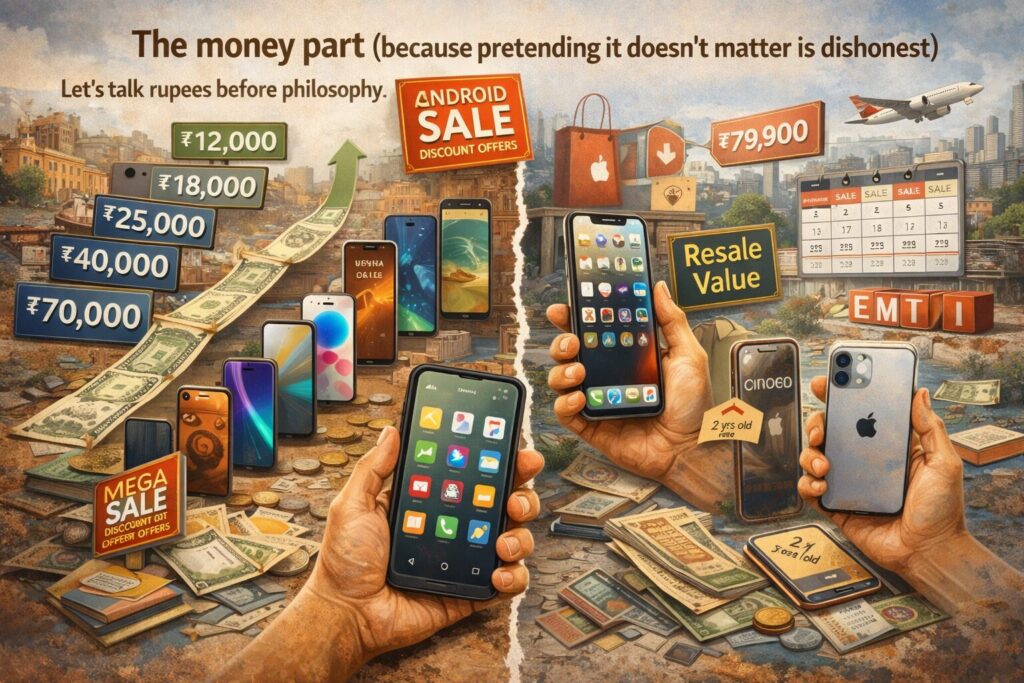
- You buy during sales
- You keep the phone for years
- You care about resale value
The sticker price is almost irrelevant. What matters is effective cost over time. A two-year-old iPhone still sells easily. A two-year-old Android depends entirely on brand and condition.
But here’s the part many people don’t admit: paying more upfront hurts more than saving later. Indian buying psychology is immediate. EMI culture hides this, but the mental math remains.
Android feels financially forgiving. iPhone feels financially strict but predictable.
Neither is “better” universally. But if cash flow matters more than long-term value recovery, Android aligns better with how most Indians actually spend.
Software: where opinions harden — or soften
I used to think Android’s flexibility automatically made it better. Then I lived with that flexibility.
On Android, you can customise almost everything. But the cost of that freedom is that the phone constantly reminds you that it’s configurable. Notifications ask for permission. Apps want default settings. System features feel layered rather than settled.
With iPhone, the first week feels restrictive. Then, slowly, you stop thinking about the phone.
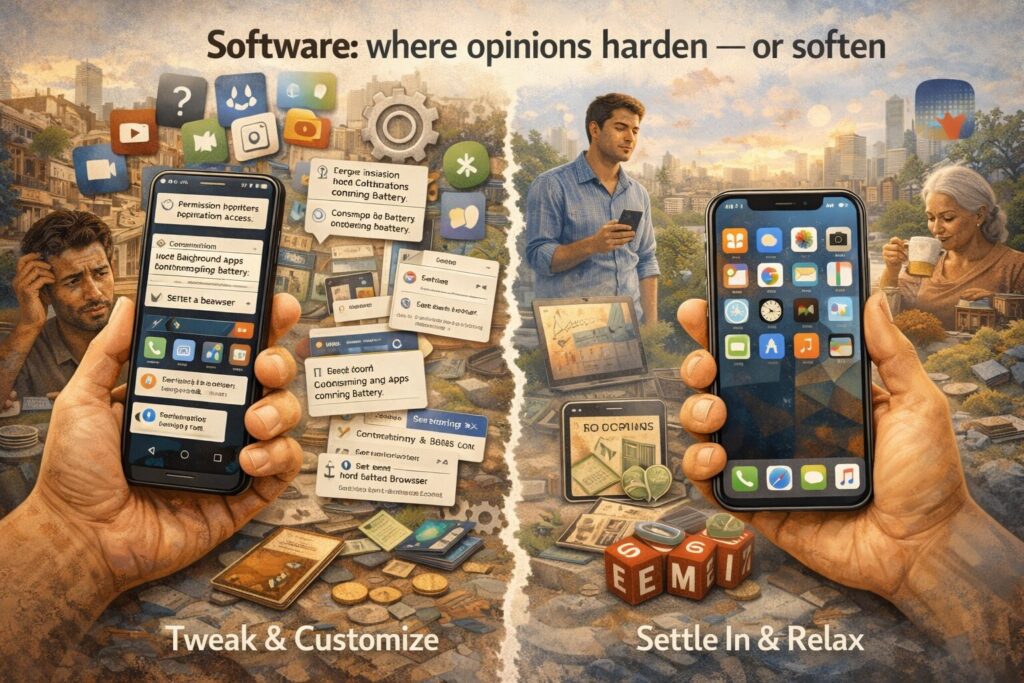
That’s the real difference. Android invites you to interact with the system. iPhone tries to disappear behind the experience.
For Indian users, this plays out in subtle ways:
- Less time spent fixing notification chaos
- Fewer background apps behaving unpredictably
- More consistent behaviour across updates
That said, Android has improved massively. Cleaner interfaces, better background control, fewer random annoyances — especially on higher-end devices. But consistency still varies by brand.
If you enjoy tweaking, Android remains satisfying. If you want the phone to get out of the way, iPhone does that better.
Cameras: what works in Indian reality, not studio tests
Indian photography is unforgiving. Harsh sunlight. Mixed indoor lighting. Faces of every skin tone. Motion everywhere.
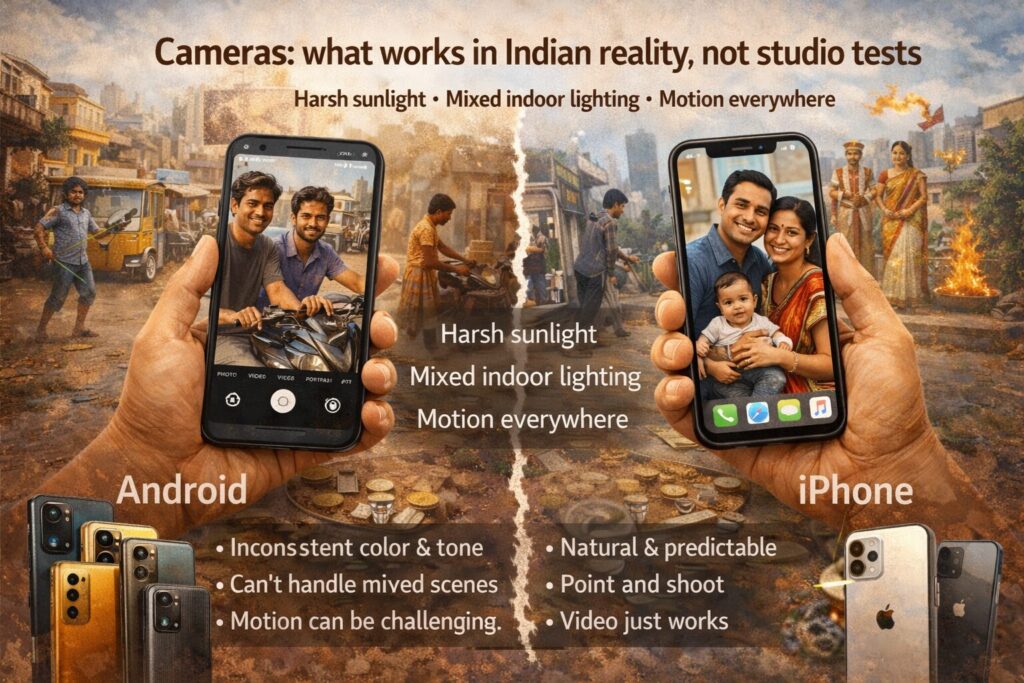
On Android, camera quality swings wildly by brand and model. Some phones excel in daylight but collapse indoors. Some oversharpen skin. Some struggle with motion. You need to choose carefully.
iPhone cameras are boring — and that’s a compliment.
Photos look natural. Skin tones are predictable. Video just works. You don’t fight the camera; you point and shoot.
For parents, creators, or anyone who values reliability over experimentation, iPhone wins here. Android can match or even exceed in specific scenarios, but consistency over time still favours iPhone.
Battery life: numbers lie, habits don’t
Android phones often have bigger batteries. On paper, they should last longer.
In reality, battery behaviour depends on software discipline. Background activity, network switching, app optimisation — these matter more than raw capacity.
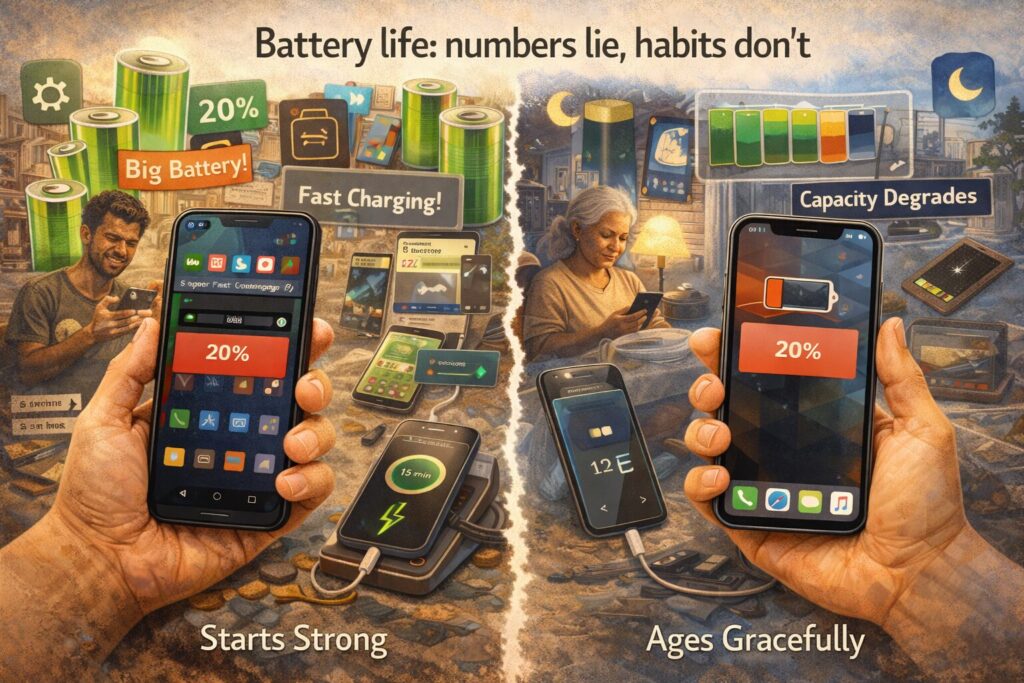
iPhones tend to age gracefully in battery behaviour, though capacity degrades. Android phones may start strong but can feel erratic after a year, depending on updates and app behaviour.
If you’re a heavy user — gaming, hotspot, navigation — Android’s fast charging becomes a real advantage. Waiting 20 minutes instead of babysitting overnight charging changes habits.
iPhone’s charging feels slow but predictable.
Again, not better or worse. Just different trade-offs.
Gaming, heat, and comfort (the unspoken deal-breaker)
Mobile gaming in India isn’t casual anymore. It’s long sessions. It’s heat. It’s sweaty hands.
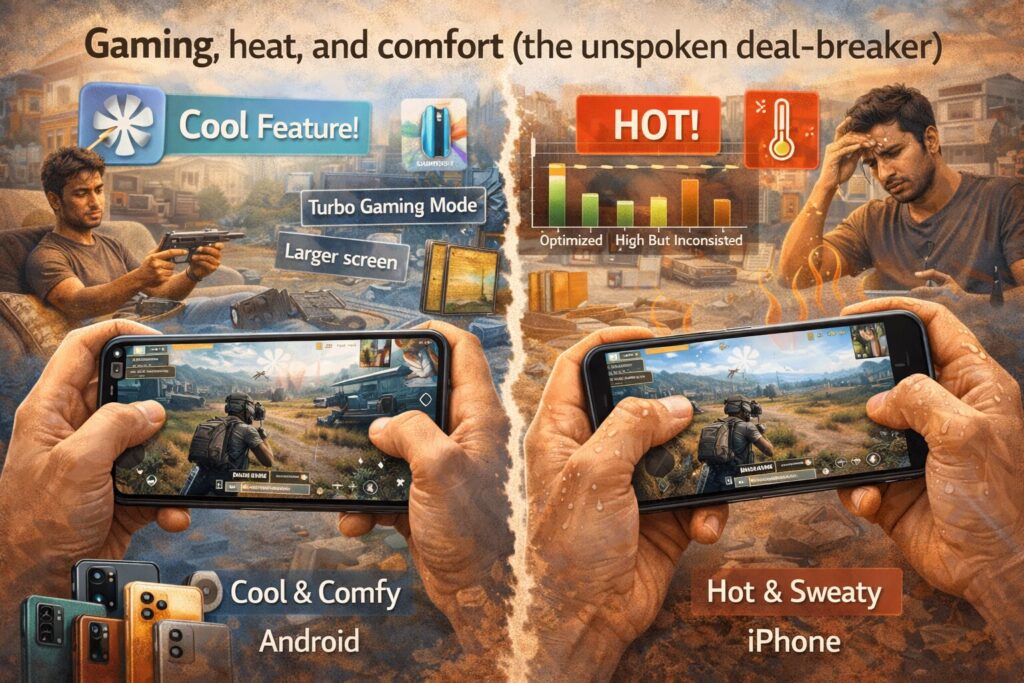
High-end Android phones are designed with this in mind — cooling systems, performance modes, larger displays.
iPhones deliver raw performance but can get warm and uncomfortable during extended gaming. They don’t advertise gaming, but they don’t optimise for comfort either.
If gaming is central to your usage, Android makes more sense. If gaming is occasional, iPhone handles it without drama.
Network reliability: where specs stop helping
This is rarely discussed properly.
A phone that works perfectly on one network may struggle on another. Signal strength, call quality, and data stability vary across regions.
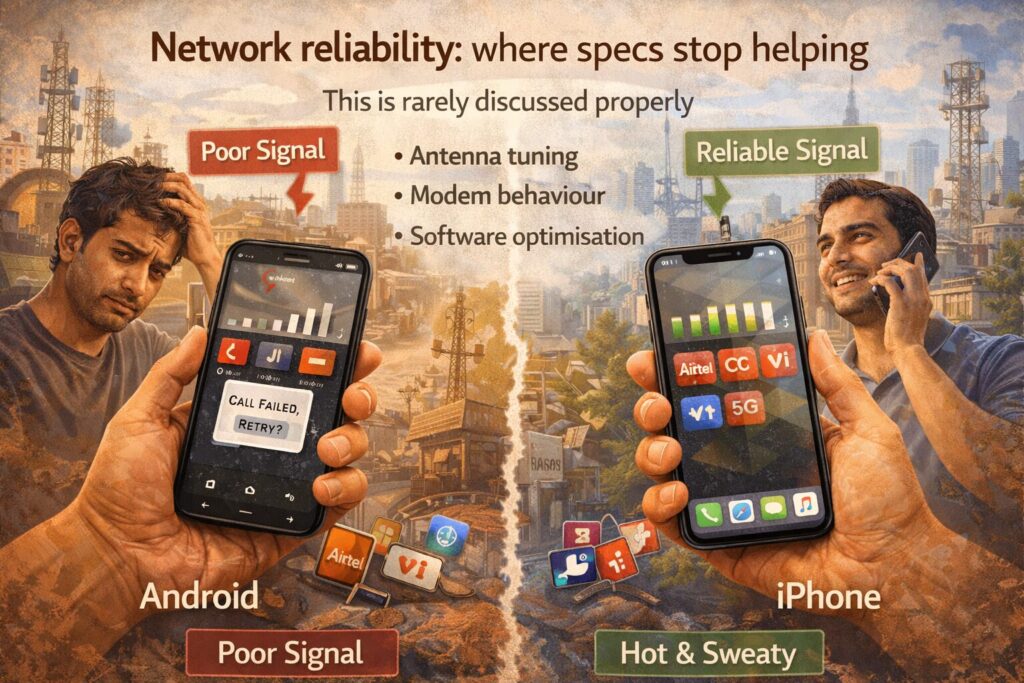
In India, network experience depends on:
- Antenna tuning
- Modem behaviour
- Software optimisation
Some Android phones drop calls indoors. Some struggle with handovers. These issues don’t show up in reviews.
iPhones tend to offer more consistent network behaviour across Jio, Airtel, and Vi — not perfect, but predictable.
If your phone is your work lifeline, this matters more than benchmark scores.
Service and repairs: nobody thinks about it until it hurts
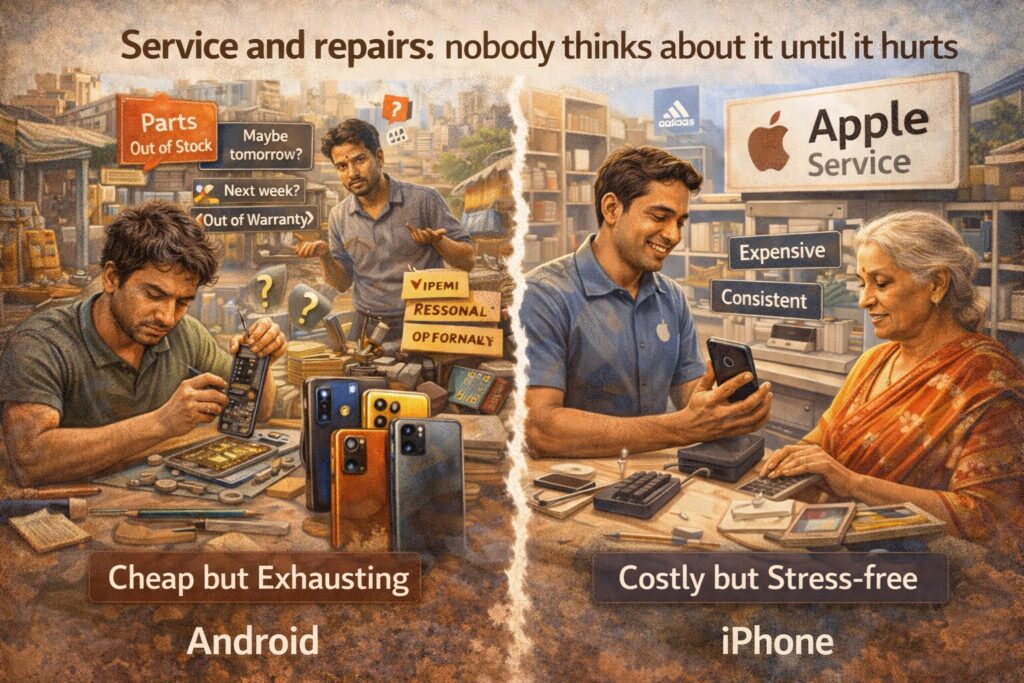
Eventually, phones break.
In India, Android service quality varies wildly by brand and city. Some brands are excellent. Others are exhausting.
Apple service is expensive but consistent. You know what you’re getting into.
For many users, peace of mind matters more than saving ₹2,000 on repair.
Pros & Cons (as honestly as possible)
Android — Pros
- Massive price range
- Hardware variety
- Faster charging options
- Better for gaming-focused users
- More control for power users
Android — Cons
- Software inconsistency
- Update reliability varies
- Resale value unpredictable
- Service experience depends on brand
iPhone — Pros
- Software stability
- Camera consistency
- Strong resale value
- Predictable service experience
- Long-term usability
iPhone — Cons
- High entry cost
- Limited customisation
- Expensive accessories and repairs
- Storage pricing hurts
Who should buy Android
Buy Android if:
- Budget flexibility matters
- You like control and options
- Gaming is important
- Fast charging changes your day
- You upgrade often
Who should buy iPhone
Buy iPhone if:
- You keep phones long-term
- Reliability matters more than features
- Camera and video consistency is key
- You value resale
- You don’t want to think about the phone much
Long-term perspective (this is where decisions age well or badly)
The biggest mistake Indian buyers make is buying for the first month.
The right question is: How will this phone feel after one year? Two?
Android rewards curiosity early. iPhone rewards patience.
Neither choice is wrong. But mismatching your temperament with the ecosystem leads to regret.
Final verdict
So, Android vs iPhone — which is better for Indian users?
The honest answer is that neither is universally better. But one is usually more suitable.
Android fits India’s diversity. Budgets, use cases, priorities — it adapts.
iPhone fits India’s aspirational stability. Fewer decisions, fewer surprises, fewer regrets if you can afford the entry.
If you want freedom, Android feels like home.
If you want calm, iPhone earns its place.
That’s not a spec comparison. That’s lived reality.
FAQs
Is iPhone worth buying in India now?
Yes, if you buy during sales and plan to keep it long-term.
Does Android offer better value in India?
At most price points, yes — especially below ₹40,000.
Which lasts longer in real use?
iPhones tend to age more predictably. Android lifespan depends heavily on brand and model.
Is service a big deciding factor?
Absolutely. It often matters more than features.
Recent Posts
- How to Choose the Right Smartphone in India: A Complete, Honest Buying Guide (2026)
- Xiaomi 17 Ultra Leica Edition Review: Ultimate Camera Phone for India?
- Best Smartphones Under ₹20,000 in India (2026 Buying Guide)
- Motorola to Launch New ‘Signature’ Smartphone Series in India on January 7
- iPhone 16 Becomes World’s Best-Selling Smartphone of 2025: Report
[…] Android vs iPhone: Which Is Better for Indian Users in Real Life? […]